Monday, June 4, 2012
In Miami, "Still The Same" Not Just A Bob Seger Song
Sunday, April 29, 2012
Thoughts on Day 1
* Joakim Noah was a French-Swedish-Cameroonian-Yankee-Gator terror for Chicago, grabbing every board in sight and jamming home dunks with a ferocity that must have scared Spencer Hawes, his fellow 2007 draftee. Sadly, Derrick Rose suffered a devastating injury in the final two minutes of the game. Rose's body has been unsturdy all season, and poor muscle alignment may have contributed to his ligament tear. With Dwight Howard and Rose out of the Eastern playoffs (and Ray Allen hobbled), the Miami Heat should have a relatively easy team breezing through the first three rounds.
* For the skipper of a battered team, Orlando's Jameer Nelson appeared oddly confident in the TV interview closing the first half, and this joie de vivre carried through the whole game. With Hedo Turkoglu back in action, the Magic have their whole squad intact without injured center Dwight Howard. Forward-sized Glen Davis put up big numbers in the middle for Orlando, and Indiana's smallish guards could not conjure any offense in the closing minutes.
* Save for the Western finals of '09, this is the biggest series of Carmelo Anthony's career, yet he allowed his longtime friend and rival LeBron James to repeatedly outplay him yesterday afternoon, capped by a long straight-on three-pointer that James drilled in the fourth with Anthony attempting to face-guard the bigger man. With Iman Shumpert also tearing a knee ligament, sadly, in yesterday's game, Knicks are now down two talented young guards. Still, Baron Davis and J.R. Smith are gamers and can at least match the combined scoring output of Wade and Chalmers. The Knicks' front line should be able to dominate Chris Bosh and company; let us see if they can vindicate their fat contracts.
* The Thunder were fortunate to pull out a victory in the day's final contest. Jason Kidd, who has looked remarkably slow and ineffective all season (this was his first season without a triple-double), was just as spry as he looked last spring while defending Kobe Bryant, Kevin Durant, and James on the Mavs' path to a championship. Recall his hustle play late in the fourth quarter last night to beat James Harden to a loose ball, then fling it cross-court to a teammate from a seated position before Thunder defenders could swarm him. The Thunder's top four players put up 19, 22, 25, and 28 points on the ticker, but the team still needed a lucky bounce with 2 seconds left to put away the Mavericks. An early loss could have deflated the Thunder; Dallas's moral victory may propel them to more success.
Tuesday, June 14, 2011
Hail to the Mavs, Hardly A Team of Lovable Losers
So the Dallas Mavericks closed out Miami Sunday night to claim their first NBA championship. I was touched by a few sights: Dirk Nowitzki walking off the court before the final buzzer, unable to contain his emotions; Chris Bosh bitterly covering his face as he walked to the locker room, feeling the mirror of what Nowitzki felt; and Mark Cuban bringing in Donald Carter to receive the Larry O'Brien trophy. Many have long thought that Nowitzki and Jason Kidd, at the least (not to mention several of Dallas's other veterans) deserved a championship to cap their careers. However, team prizes are not given to individuals for lifetime achievement; the LOB must be earned by playing the best basketball of any team in the league. This year, that was Dallas, which outpointed the two-time defending champs, the anointed team of the future, and the league's most talented team on its way to the 2011 title.
It is interesting how this year's two Finalists represented a fairly clean break from the playoff behemoths of the last several seasons. After the memorable NBA Finals series of 2006 that matched these two teams, Dwyane Wade and Dirk Nowitzki struggled for the next few seasons while the Spurs, Suns, Lakers, Cavs, Pistons, Magic, and Celtics cleaned up in the playoffs. Wade's team lost three first-round series in the subsequent four years (including an embarrassing sweep by the young Bulls in 2007) and missed the playoffs in 2008. Nowitzki's Mavs lost three first-round series in the next four campaigns and lost in the second round in '09. In the press conference before Game 6, Nowitzki described the annual "hammering" that superstars receive from fans and pundits when they fail to end their season with a win.
Yet as Scoop Jackson points out here, those same observers tend to forget the years of futility once a team finally does win the sweetest prize. Jackson does not delve into the psychology of those analysts, but perhaps it is a case of the "fundamental attribution error" recognized by formal psychology: observers want to place Nowitzki, say, into one of a small number of personality types. They want to say he is soft, or tough, or killer, or clutch, or weak, or overconfident, or smart, or selfish, or stupid. They want to consider him as possessing such attribute innately and forever, rather than considering that he may possess many of these types, and his types might change over time. They also fail to note that contingent, situational factors outside the superstar's grasp like injuries, playoff upsets to other contenders, lucky roster moves, and the like can spell the difference between a championship or none, regardless of how well the star plays. Coupled with the natural psychological tendency to consider recent data and positive data (compared to old and negative data) more keenly, this makes it easy for observers to now consider Dirk a "winner", instead of updating their view of his career in a more nuanced fashion. Nowitzki actually seems canny, from this perspective, to a win a title later in his career rather than earlier; Wade, who won his lone title (the same number as Nowitzki) in his third year, now has to answer more questions about his winning capacity than Mr. Swish41 does.
Dallas is hardly a cuddly underdog: their aggregate player salary of about $84 MM for the 2010-11 season ranks third in the league. The internet mania of the late 1990s gave Mark Cuban a lot of money; he is one billionaire who seems to value winning over turning an economic profit on his team, to the extent that those two objectives clash, as I discussed a couple years ago. Dallas lost two-time All-Star Caron Butler to injury in January, and was able to fill his SF slot in the starting lineup with... four-time All-Star Shawn Marion! To plug Marion's spot as backup small forward, Dallas signed... three-time All-Star Peja Stojakovic. When Stojakovic's defense against Miami's star wings proved terrible in the Finals, Dallas was able to spell him with their fourth-string small forward, Brian Cardinal, a former $40 MM backup for Memphis. Dallas also boasts FOUR starting-caliber point guards, two starting-caliber centers, and a former Final Four MVP in Corey Brewer, who barely played in the playoffs. Due to arcane NBA rules dealing with player movement, Cuban even paid over $2 MM this season to three players (Buckner, Novak, Thomas) With a owner like Cuban, Dallas should always be in the upper layer of teams. Even when Nowitzki slows and retires, top players should be keen to play for a big-spending owner who funds sleek locker rooms.
Many commenters are fussing that Miami's roster is fatally flawed and the Bosh-Wade-James troika should be broken up. But by most teams' standards, the Heat had a wildly successful season, finishing with the third-best record in the league and blitzing 12-3 through the Eastern playoffs. In the Finals, their lack of a good center hurt them, as Tyson Chandler was able to discourage any offensive forays down low by the three Heat stars, without worrying about Joel Anthony doing much left unattended. A summer of shooting practice by the two wing stars, plus the addition of a good two-way 7-footer younger than 35, plus a full training camp (recall that Wade was injured throughout last October) will help Miami improve, and they should rightly be considered next year's title favorites. There will be many free-agent centers in July [or after the completion of a labor agreement] including Sam Dalembert, Marc Gasol, Greg Oden, Yao Ming, Spencer Hawes, Nene Hilario, and the aforementioned Chandler. However, any center with his eyes on Miami will need to accept relatively low pay: Miami can offer only the mid-level exception [i.e. league average] salary, or if that option is killed in the new labor agreement, then perhaps just the veteran's minimum, to free agents.
Congratulations to Dallas!
Friday, June 10, 2011
Notes on Game 5
The Mavericks won Game 5 of the Finals last night, giving them a chance to take the championship with just one win in Miami. Of course, Detroit in 1988, New York in 1994, and Boston in 2010 were in similar situations, up 3-2, but could not break the serve of their opponent in the road arena. Dallas will need to work even harder than they did tonight (the Mavs' effort was exemplified by Brian Cardinal, who repeatedly put himself in a good-faith position to receive charging calls against driving Miami players) to win a fourth game in this series. If they relent just slightly, Miami will quickly win two games and celebrate next Tuesday.
During the past two games, Dallas has missed Brendan Haywood (hip). DeShawn Stevenson had his knee drained after Game 4. Since January, they have been without erstwhile starting SF Caron Butler (knee). Dirk Nowitzki has a busted finger and is recovering from a sinus infection. Their three-guard rotation has an average height of 6'1". Yet they still took two of three games from the Heat in Miami. Dallas's coach Rick Carlisle has expertly managed his players' minutes while still ending each game with his best lineup of Kidd, Terry, Chandler, Marion, and Nowitzki. Marion's once-receding hairline and his unorthodox low-post game seem to have returned to their formerly robust condition circa 2003. What technological assistance Marion received for these two miracles, I do not know.
Dallas was out-assisted tonight, 25-23, and out-rebounded 36-26. Dallas only snared 26 boards, worse than the average of the worst regular-season team! FG attempts and FT attempts were roughly equal; the difference in the game, if we are to focus only on math, was the Mavs' 13-19 performance on three-pointers, against Miami's 8-of-20 night from beyond the line.
ABC's Jeff Van Gundy criticized young Ian Mahinmi for giving up a couple easy baskets to Chris Bosh. Weak defensive play is not surprising for an inexperienced player appearing for only the fifth time ever in the NBA playoffs (including one game with the Spurs last spring). However, Mahinmi grabbed a couple fierce rebounds and loose balls and generally did not embarrass himself while on the floor.
Dallas closed the game on a 17-4 run starting at the 4:22 mark, after Miami found several holes in Dallas's defense midway through the fourth quarter, punctuated by a James-to-Haslem dish and dunk. Down 96-95, Rick Carlisle called a timeout. Following the break, Dallas showed great ball movement on their next few offensive sets, as Jason Terry delivered the ball to Dirk Nowitzki for a dunk and to Jason Kidd for a game-clinching three-pointer. On defense, Dallas used the strength of Jason Kidd (who, as I noted on this blog earlier, was able to defend Kevin Durant in the previous series) to slow Lebron James from slipping loose for too much havoc.
Throughout the game, J.J. Barea took several ill-advised three-point shots while decently guarded, but still managed to sink 4 of 5 from that distance, matching the contribution of his counterpart Mario Chalmers. Chalmers, who made his reputation as a big shooter back in college and has done nothing to sully it in these Finals, made a mildly ridiculous shot at the end of the first quarter, throwing in a one-hander on the run from half-court while falling sideways. With Mike Bibby averaging 3.8 points and 1.0 assist in five Finals games, it is unclear why coach Erik Spoelstra continues to put him on the court to start games.
I predict Miami will win two very tight games down in Florida. Dallas has played great so far, but the Heat are very hard to beat at home. Without a 15-point Mavs comeback in Game 2, the Heat would be undefeated at home for the playoffs. (And add a couple more lucky breaks in Game 4, and the Heat could have swept the series.) Much credit is due to Dallas for finding a way to grab three wins. But I do not believe they will win another.
Friday, June 3, 2011
Game 2 Notes
As the late Ralph Wiley once put it, the NBA Finals is the highest level of hoop. Sure, talented individuals like Rose, Durant, Bryant, Howard, Paul, Griffin, Love are not represented here, but this is a team game and stats alone don't yield wins. If stats gave wins, Mitch Richmond would have more than one ring.
We must keep this in mind when contemplating Dallas's two-point victory in Game 2 last night, 95-93. How could a 38-year-old point guard, a 6'2" shooting guard, a center that a center-less team refused to take, a 7'0" shooting guard, and a guy on his fourth team in four seasons beat the most talented and athletic group of guys in the league?
Excellent coaching strategy helps, but the confidence of veterans is yet more important. As I noted in April, teams with no prior playoff series wins never win the NBA title in any given year. It is also hard to expect a Chris Bosh to suddenly thrive in the NBA Finals, after never winning one playoff series in Toronto from 2003-04 through '09-10. Jason Kidd has never been known for fancy dribbling, but his pedestrian handle almost never loses control of the game.
Again and again last night, I watched Miami's defense force turnovers from Dallas's suite of small guards. Barea and Terry (and even Kidd, a bit) had their ball poked loose, or saw their shot blocked or altered, too many times to keep coach Carlisle tranquil. In all, Miami notched 15 steals and 8 blocks for the night; seven of Miami's eight players logged at least one steal. These numbers don't do enough to convey the swarming intensity of Miami's defense (for the first 42 minutes of the game, that is); Dallas repeatedly had trouble initiating basic offensive sets or using ball movement to create space. Meanwhile, Miami used these turnovers and possession changes to launch quick strikes to the other side of the court, slamming through numerous crowd-charging dunks. But late in the game, when Dallas learned to flummox the defense with better-executed screens (or double screens), the Mavs were able to begin the offensive show they displayed against Los Angeles and OKC.
With 3:11 left, Jason Terry to hit a jumper to cut the deficit to 4 points, and Miami knew they were troubled. Immediately after a Miami timeout, Chris Bosh dribbled the ball out of bounds for no reason, leading to a quick Nowitzki jumper that made things a single-basket game. After a few missed baskets, Shawn Marion led a fast break down the court and wisely flipped the ball to Nowitzki to evade a defender. Nowitzki laid in the ball, tying the game. After another Miami timeout, Dirk Nowitzki hit a three-pointer. Finally [after a tying bucket by Mario Chalmers], Nowitzki drove the ball one-on-one against Chris Bosh and hit the winning layup with his left hand at 0:04. LeBron James, guarding Jason Terry in the corner, couldn't decide whether to help against the Nowitzki parry or to stay with his man. James simply stood as a spectator and watched Nowitzki easily streak to the basket. Bosh also failed to commit his team's "foul to give" when Nowitzki began to dash free. [In the postgame press conference, Bosh admitted to poor defense on the final play against Nowitzki, but I did not hear James cop to anything similar.]
Bosh and James didn't know what to do, or were not able to make the right decisions in the required time frame. Nowitzki, Kidd, Marion, and Terry barely needed to think.
At this point I sincerely cannot say who will the series. Miami is slightly better, but Dallas has 3 of the 5 remaining home games. I recall a couple recent playoff Game 2s where a last-second game-winning shot gave an undeserved win to an apparently inferior team that had lost Game 1. Recall Kobe Bryant tying up the Pistons (sending the game to OT, to be eventually won by LA) with a three-pointer in 2004's Game 2, or LeBron James defeating Orlando the same way in 2009's Game 2. Folks thought that "momentum" in the series had turned. But the better team usually wins out; Bryant and James both lost their respective series, in the event. An inferior team can eke out an upset once, but four times? Can't happen.
[My comparison may strike some as inapt because prior to those series, folks thought that the Lakers and Cavaliers were the better teams. But the eyeball test eventually revealed the opposite. No one argues that the Lakers-with-injured-Malone or the Cavs were the better team compared to the Pistons and Orlando in those series.]
So, Miami could still win this one. Heck, they could have won Game 2 with just one or two luckier breaks: a miss by Nowitzki, perhaps a swish by Dwyane Wade on his last-second prayer. But right now Dallas looks like the hungrier AND smarter team.
Thursday, June 2, 2011
Game 1 Notes
A few thoughts after Tuesday night's 92-84 Miami victory in Game 1 of the NBA Finals:
Peja Stojakovic looked lost on defense every time he took the floor. Against Los Angeles or Oklahoma City, Stojakovic could be assigned to guard Ron Artest, Matt Barnes, Lamar Odom, Nick Collison, or Thabo Sefolosha: relatively slow men who are not primary ball-handlers. Against Miami, which plays Lebron James and Dwyane Wade together for nearly 48 minutes straight, Stojakovic is forced to cover an All-NBA wing every trip down the floor. He shot 0 of 3 last night; if he keeps up that desultory record, coach Carlisle may be forced to yank him for Corey Brewer, who at least plays adequate defense. I wonder, too, whether the half-healed Caron Butler might be useful in 5-minute bursts.
Dallas missed a lot of open shots: J.J. Barea missed several of the Nash-like layups he usually writhes into the hoop, and Jason Terry missed a few open 3s. Including Stojakovic and Brendan Haywood, the Mavs' bench combined to shoot for 4 for 22. They will surely improve that rate next time and will score more points. Miami's whole roster shot only 39%, but their three stars still delivered 65 points; it is not obvious that Miami can find more scoring.
Miami has four seven-foot centers bound to the bench: Dexter Pittman, Jamaal Magloire, Zydrunas Ilgauskas, and Erick Dampier. Coach Spoelstra chose to employ 6'8" Udonis Haslem (30 minutes) as his backup center behind 6'9" Joel Anthony (18 minutes). Spoelstra further used 6'10" Juwan Howard for 8 minutes to spell Chris Bosh at power forward. Dallas is the only playoff team with two starting-caliber centers (non-playoff Sacramento could make the same boast; Boston could say the same if Shaquille O'Neal were healthy, as could Portland with a healthy Greg Oden), but Spoelstra chose to combat them with long-limbed agile men. Like the Atlanta Hawks (except better), Miami's typical five-man squad is not a "big lineup", as they play no 7-footers, but not a "small lineup" either, as Lebron James and Mike Miller are oversized for their respective positions. If Miami insists on eschewing its tallest guys, Dallas must find a way to exploit the Heat's short stature. I saw Dallas using a Stevenson-Barea-Terry alignment in the fourth quarter last night; if going small does not work, why not go big? Try bringing in 6'11" F-C Ian Mahinmi, who played 56 games in the regular season, to play with Dirk Nowitzki and Tyson Chandler when Lebron James leaves the game.
My suggestions to play Butler, Brewer, or Mahinmi could be easily ridiculed as desperation. Perhaps Dallas should not mess with the nine-player rotation that destroyed the Lakers and Thunder. But Miami is very, very good.
Friday, May 27, 2011
Live From the UC: Heat Close Out Bulls in Game 5
Last night, one-third of the JPO team, plus a non-JPOer who is well acquainted with all three bloggers, had the chance to attend Game 5 of the Bulls-Heat conference finals series live on West Madison St. at the United Center.
By now, all hoop fans know what happened: the Bulls were up by 10 points late in the game, but just as the Mavericks did to the Thunder, Miami used a furious offensive assault (including a rare 4-point play by Dwyane Wade), and firm defensive stands at the other end, to erase the gap, take the lead, and win the game by 3. Miami is now the Eastern Conference champion and will face Dallas next week as the NBA Finals begin.
The live crowd at the United Center was completely deflated by the end. Tom Thibodeau's squad had maintained a lead throughout the game. Expecting their Bulls to close out the win and go down to Miami for Game 6, the arena fans were caught off-guard when James and Wade began drilling shots, and utterly stunned when the final buzzer sounded and the ritual post-series handshakes began. However, this suggests the fallacy of casual observation in a basketball game. If a team builds an early ten-point lead and then maintains that lead for, say, 30 more minutes, it is not correct to think that the leading team "dominated" the game heretofore, as many commentators would say. Actually, in my imagined example, the leading team dominated an early stretch in building that margin, but the subsequent 30 minutes (most of the game) were played evenly, and the trailing team likely has the potential to pull off a quick ten-point run at any moment. This is roughly what happened in last night's game, as Chicago took a lead 9 minutes into the first quarter and did not relinquish that lead until 1 minute remained in the game.
In any case, I want to highlight through video (taken on my very non-professional camera) some key moments from this game.
On this play, Derrick Rose jumps upon Dwyane Wade's up-fake, and Wade draws two foul shots. Wade is not known as a great perimeter shooter; with more experience, Rose would have the patience to not "bite" on that fake.
On this play, the Heat catch both of Chicago's big men, Joakim Noah and Carlos Boozer, out of position. With much empty space between himself and the rim, Chris Bosh capitalizes for an easy drive and lay-in.
Despite his lazy defense on that above play, I believe Boozer has been criticized too much during these playoffs. On this below play, watch as the Alaskan uses his wide body to set two sturdy screens. The first knocks Mike Bibby to the ground, and the second momentarily detours LeBron James, giving Luol Deng enough space to launch a good jumper, which he unfortunately missed.
Additionally, when Boozer gets the ball, the Heat certainly respect his offense in the painted area. On this play, watch Dwyane Wade and Chris Bosh (covering for Boozer’s assigned guarder, Joel Anthony, who got somewhat lost on the play when he shaded over to double-team Rose) converge on Boozer the moment the latter receives the ball at the free-throw line. Boozer correctly passes out of the double-team. Thanks to Mike Bibby’s completely forgetting about Derrick Rose, Rose is eventually able to swish an open three-pointer on this play.
In this fourth-quarter play, Luol Deng sneaks free after Dwyane Wade tires of trying to guard the much taller small forward. I include this one to illustrate that Miami’s swarming defensive philosophy often leads to wide-open looks. Deng is not even visible as the play starts, as he camps out in the lower right corner. Deng is easily able to shake loose of Wade’s sentry, and Wade then decides his service would be better rendered by banging in the post with Taj Gibson for a rebound. Deng is suddenly wide-open. LeBron James, ostensibly guarding Derrick Rose by this late moment in the game, does not bother to impede Deng as he streaks toward the hoop, receives a nice bounce pass from Kurt Thomas, and draws a foul.
Tuesday, May 24, 2011
Dallas Achieves The Near-Impossible
Last night Dallas came back from a 15-point deficit with 5 minutes left, riding some stupendous baskets by Dirk Nowitzki and a stern defensive effort to force overtime and eventually defeat the Thunder. Dallas now leads the series 3-1 and will likely advance to the NBA Finals.
A few points come to mind.
—————————
Who would have thought that Kevin Durant could be solidly defended by a 6'4" man old enough to be his father?
—————————
In the last 32 seasons, the Western Conference has been won by the following teams (assuming Dallas does close out the series):
And in the last 12 seasons, only the Lakers, Spurs and Mavs have taken Western gold.
Following Sacramento, New Orleans, Denver, Memphis, Minnesota, Golden State, and the Clippers cannot be much fun. Heck, there has only been one year during the past 30, 2004, in which Minnesota advanced past the first round. The same goes for the Clippers (2006) and the Grizzlies (2011)). Without a superstar, there is no glory, and only a handful of all-timers exist at any given moment.
—————————
As spectacular as Dallas played down the stretch last night, they were still less than perfect. The Mavs nearly won last night's game in regulation; a missed free throw by Shawn Marion and a botched fast-break layup by Jason Terry in the final minute could have augmented the 17-2 run. Credit Thabo Sefolosha for excellent defense on a barreling Terry.
—————————
As I wrote a few days ago, the Thunder cannot win this series by single-covering Dirk Nowitzki. The Thunder have a surfeit of big men including Nazr Mohammed and Cole Aldrich, last year's first-round draft pick. Put those guys in the game and tell them to foul Dirk like crazy! Particularly when Brendan Haywood plays, Oklahoma likely realizes positive value from leaving Haywood to double-team Nowitzki.
—————————
In every late fourth-quarter situation in the NBA, every trailing team hopes to complete a comeback like this. It usually doesn't happen, but the salience of crazy recoveries (Reggie Miller's 8 points in 9 seconds, Tracy McGrady's 13 points in 35 seconds, Miami over Dallas in Game 3 in 2006, Derrick Rose over the Pacers in Game 1 this year) allows all similarly-positioned teams to wonder whether they might be so fortunate. Blame Dirk Nowitzki's heroics last night for all the future fourth quarters that last 45 minutes in a mess of fouls and feckless timeouts.
Wednesday, May 18, 2011
Dallas Is Not Fast, Still Furious
Dallas defeated Oklahoma City by 9 points on Tuesday night, showing that this series will pit speed against savvy. Dallas fields seven guys over 30 in their nine-man rotation; nearly all of Oklahoma's rotation players are 26 or younger. Note, now, that it is generally true that teams advancing far into the playoffs feature veterans. A stud prospect like Kyrie Irving or Derrick Williams is unlikely to lead a playoff contender until his fifth or sixth year, at least; ideally, he will continue to lead teams well into his 30s. Players who star in the playoffs in just their third season, such as Dwyane Wade in '06 or Derrick Rose and Russell Westbrook this year, are the exception. If Oklahoma City can defeat the Mavs, I will be surprised.
Observe the video below. Dallas has no answers defensively when the young Thunder players turn on the jets. Witness, for example, Russell Westbrook's mad dash at 0:52 of this video or Durant's one-man fast break to close the first quarter (1:02 of the video).
But Dallas gets its points with expert ball movement rather than raw quicks. Watch the play starting at 1:05 of the video. How does 6'2" shooting guard Jason Terry do so well? First, he often plays against second-string guards, who are either too weak or too inexperienced to adequately check him. (Second, when he plays with Jason Kidd, Kidd matches up against the opponent's taller guard, freeing Terry to excel at both ends.) In this play, Eric Maynor completely forgets about Terry, leaving Terry wide-open for about five seconds before JET receives the ball and launches an easy three-pointer.
At 1:16, watch little J.J. Barea (really) successfully setting a screen against Dirk Nowitzki's defender Nick Collison, freeing Nowitzki to easily receive an inbounds pass and hit a layup. Collison has about 12 inches and 100 pounds on Barea, but he still couldn't get past the smaller guard. Additionally, backup center Nazr Mohammed appears to be wearing army boots, as he is standing directly under the basket yet does nothing to impede Nowitzki's easy bucket.
Kevin Durant shot 18 of 19 from the free-throw line and Dirk Nowitzki shot, improbably, 24 of 24. As described here, the Thunder chose not to double-team Nowitzki, allowing him to repeatedly bust free for big points. OKC will likely lose the series if they continue this approach.
Friday, May 6, 2011
Lefties Living Large
With U.S. President Barack Obama basking in his administration's killing of Usama bin Laden and a favorable jobs report for April 2011, left-handers are on top of the world right now. In the NBA playoffs, most of the top teams feature at least one left-hander who successfully discombobulates opponents by dwelling in a confusing mirror-land. My significant other is also an inveterate southpaw, so I am partial to the reverse racket. Here is a review of the top lefties of the NBA playoffs:
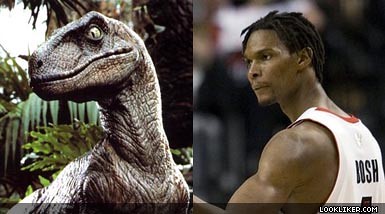
Chris Bosh: Bosh has thus far played adequate defense on Philly's Elton Brand and Boston's Kevin Garnett, limiting each guy to about 15 points per game. For his part, Bosh has averaged nearly 18 points and 10 rebounds in the playoffs, consistently giving Miami the big presence they need to keep defenses from double- or triple-teaming his mates James and Wade. Miami is 6-1 in the playoffs thus far and is the clear favorite to win the East, given injuries to the Celtics' and Bulls' best players. If the Heat defeat Boston, the velociraptor lookalike will need to raise the fury of his offensive game as the Heat move on to face stalwart defenders like Joakim Noah, Al Horford, Andrew Bynum, Kendrick Perkins, or Tyson Chandler.
Zach Randolph: Randolph has been a monster in the playoffs thus far, averaging 22 points and over 7 FT attempts (making the latter at an 87% pace), giving his team ridiculous offensive efficiency. Randolph has carved up Tim Duncan, Antonio McDyess, DeJuan Blair, Serge Ibaka, and any other defender who cares to challenge the big Hoosier. At the end of Game 6 of the Spurs series, San Antonio pulled ahead 80-79 with about five minutes left. The young Memphis team could have crumbled, but Randolph then scored 13 points down the stretch, throwing in a variety of awkward-yet-graceful parries at the basket to lead his team to a comfortable 8-point win, closing the series.
Lamar Odom: Odom has not played to his potential in these playoffs. Defending Carl Landry of the outmatched Hornets, Odom allowed the backup power forward to rumble for 16 points per night. On offense, Odom has produced only about 11 points and 7 rebounds, and only 4 total three-pointers in six games. With Ron Artest sentenced to one game out of action, Odom will enter the starting lineup tonight and will take direct responsibility for stopping Shawn Marion and/or Dirk Nowitzki.
James Harden: Harden's beard and mohawk are intimidating, but he has been a bit inconsistent in the playoffs, putting up point totals of 5, 18, 10, 7, 12, 5, and 21. His most recent output, Game 2 against Memphis, was his best, including 5 assists, 3 steals, and 11 free-throw attempts (with a perfect completion rate). However, Harden needs to stroke outside shots more consistently (he averages only one three-pointer per game) to discourage Memphis defenders from converging all their might on Durant and Westbrook. Oklahoma City's other rotation players — Perkins, Sefolosha, Ibaka, Mohammed, and Collison — are not known as major offensive threats. Only Eric Maynor's surprising long-distance result in Game 2 kept the Grizzly defense at bay, and Maynor may not repeat that.
Josh Smith: Smith is, as ever, inconsistent; he is surely the most talented player to never make the All-Star Game (edging Odom, discussed above, and Monta Ellis and LaMarcus Aldridge for that designation). Here is Charley Rosen's evaluation of Smith following the Bulls-Hawks second game a couple nights ago: "Smith had only himself to blame for his abysmal 4-of-14, four-turnover performance. That’s because he forced a total of eight shots/passes/drives, with most of his turnovers being of the unforced variety." In the first-round series with Orlando, Smith did a good job of limiting Brandon Bass to only 7 PPG and 4 RPG, well below Bass's regular-season averages. But on offense Smith has been just dead weight, averaging 39% from the field, 56% from the free-throw line, and 17% from three-point range (on his 2.4 attempts per game). Smith could average 5 or 6 assists per game with his height, vision, and agility, but he peaked at 4.2 in 2009-10, and dropped to just over 3 assists this season, and just under 2.6 assists these playoffs.
Derek Fisher: Fisher has spent these playoffs allowing Chris Paul and J.J. Barea to repeatedly abuse him. Should the Lakers somehow advance to face Memphis or (particularly) Oklahoma City, Fisher's defensive weakness will become still more patent. At 6'1", Fisher was never the hulkiest of defenders against opposing PGs, and now he is nearly 37 years old. Fisher is not giving his team in credits nearly what he takes away in debits, averaging only 8.5 points and 4 assists in this postseason. But he still shoots a pretty jumper.
Mike Conley, Jr.: In his first NBA playoffs, Zach Randolph's teammate has done well against good-to-excellent point guards like Ty Lawson, Ray Felton, and Russell Westbrook. Conley has raised his scoring average slightly, from 13.7 in the regular season to 15.6 in the playoffs. Additionally, Conley has done a good job (6.5 assists against Denver and Oklahoma City) delivering the ball to his big menaces Marc Gasol and Randolph, who know how to score it. Conley reached the NCAA tournament final four years ago in his only college season, so he is not unaccustomed to serious pressure.
Manu Ginobili: This 6'6" guard is the only man on my list not still playing in May. Ginobili is a great player, but he was limited in the Memphis series by an elbow injury that he suffered when, oddly, his coach had him playing in the season's final game, which was meaningless to San Antonio's relative standings. Ginobili hit a very lucky shot to help force overtime at the end of Game 5 and averaged 20 points per game in the series, but he was unable to stop marginal offensive talents like Tony Allen and Sam Young from carving up the Spurs in the paint, and now his year is done.
Other left-handers like Tayshaun Prince, David Lee, Michael Redd, and Mike Beasley all play for 2011 lottery teams. Prince, who has seen plenty of prior playoff success, might make his way to a winning team as a free agent this summer.
Sunday, May 1, 2011
First Round of the Playoffs
With the first round over, here are some quick observations:
New Orleans had great success with the pick-and-roll against Los Angeles; on several occasions in Game 4, I saw Andrew Bynum forced to defend Chris Paul one-on-one after switches. The big man gamely saw in a defensive crouch to defend Paul, but the latter torched Bynum for swished jumpers time after time.
LaMarcus Aldridge has become very, very good in the low post. Nicolas Batum is a nice two-way player. Greg Oden, if healthy, can form an outstanding defensive line with Aldridge. Gerald Wallace is a great sixth man. All Portland misses is an All-NBA caliber guard. Unfortunately, Brandon Roy's knees are not what they were in 2009. Committed to Roy through 2015, Portland has little hope of crafting a championship contender.
I was surprised that San Antonio repeatedly had no answer for Memphis's slow, arboreal attack. Unfortunately, Antonio McDyess is too old, Matt Bonner too slow, and DeJuan Blair too short to deal with Randolph or Gasol. On the other end, one would think that Parker and Ginobili could repeatedly hit outside jumpers against the inexperienced defense of Sam Young, Mike Conley Jr., and O.J. Mayo. Unfortunately, Memphis's perimeter players (including the excellent Tony Allen) are relatively tall, and Parker is not; also, Ginobili was slowed by an elbow injury.
Denver had a full company of troops to do good combat with Oklahoma City, but they were outplayed late in their losses. Excepting the blowout Game 2, here are the fourth-quarter scores and the final scores. Game 1: Tie in 4th quarter, OKC wins by 4. Game 3: OKC by 5 in 4th quarter, by 3 overall. Game 5: OKC by 7 in 4th quarter, by 3 overall. The Thunder have Kevin Durant to get results in crunch time; Denver's best scorer is Danilo Gallinari.
The Celtics may have swept New York, but we should not infer too much from this outcome. Boston could barely defeat NY in two games at home, enjoying some lucky bounces and mental miscues by the Knicks in the fourth quarter. When the series moved to Manhattan, had little trouble dealing with a team missing Chauncey Billups and a healthy Amare Stoudemire.
Similar to Dallas's problem, Orlando fields a 5'11" point guard as its second-best player and alleged team leader. Its shooting guard going forward, J.J. Redick, is 6'4". How on earth can these guys hope to defend Derrick Rose, Dwyane Wade, or Ray Allen? They certainly couldn't do it against Joe Johnson and Jamal Crawford, who averaged 18 and 20 points, respectively, in six games of their first-round series. Worse, Orlando's contractual commitments to Hedo Turkoglu (through 2013) and Gilbert Arenas (through 2014) preclude the team from making any good trades or adding good free agents. Dwight Howard would be crazy to re-sign here.
The Pacers surprisingly kept the first three games close and won the fourth, thanks to superstar play by Danny Granger and necessary buckets from their big players, Hansbrough and Hibbert. Chicago had a difficult time pulling away from Indiana in the first four games, in part because Carlos Boozer only scored 12 PPG in those contests. Without Boozer throwing in a regular 20 points per, the Bulls generally lack scoring punch. Their first priority for improving the roster must be finding a two-way SG who can throw the ball through the rim and stop the opposing counterpart.
Like the Pacers, Philadelphia played Miami tight in four of the five games: three of Philly's losses came by 8 points or fewer. With young players like Holiday, Young, Turner, Williams, and Iguodala, the Sixers are one of the few teams in the league that can play at Miami'a fast pace; Iguodala in particular helps the 76ers run up and down while staying with Miami's stallions defensively. Only an ultra-quick or ultra-strong team can probably defeat Miami in four games out of seven. The Boston Celtics, unfortunately, reduced their strength significantly when they traded Kendrick Perkins.
Thursday, April 14, 2011
Playoff Predictions
The 2011 playoffs begin this weekend, so here are our quick thoughts:
Other than the Trail Blazers of 1977, no team has ever won the championship if its core players had not even won a single playoff series in prior years. (One could point to the 1980 champion Los Angeles Lakers featuring rookie Magic Johnson, but its other top players including Jamaal Wilkes, Michael Cooper, and Kareem Abdul-Jabbar had won a first-round series against Denver in '79. One could also look at the Celtics of 2008, who turned the previous season's 24 wins into a championship. But Pierce, Garnett, and Allen had all made it to the conference finals with different prior teams.) This is not a random correlation; beating the same opponent over and over, even as the opponent comes to know your strengths and weaknesses, is a learned skill. For that reason, I have a hard time seeing the Chicago Bulls or Oklahoma City Thunder winning the 2011 title. (The Bulls boast Boozer and the Thunder play Perkins, both of whom have seen playoff success before, but each of those guys is not among the respective team's top three players.) That is not to say that Chicago and Oklahoma cannot make the NBA Finals, but they will likely not win the big prize.
That leaves San Antonio, Los Angeles, Dallas, Miami, Boston, and Orlando as possible champs. Keep that in mind in reading the following predictions:
FIRST ROUND
SECOND ROUND
CONFERENCE FINALS
NBA FINALS
Friday, March 18, 2011
Utah vs. Chicago '98
I noticed a few things in this game that had slipped from my memory:
Friday, June 4, 2010
Finals Home-Road Format Is Close To Irrelevant
In last night's Game 1 between Los Angeles and Boston, ESPN/ABC's Jeff Van Gundy proposed changing the NBA Finals format from 2-3-2 (two home games for Team A, three home games for Team B, two home games for Team A) to a 2-2-1-1-1 format, which is used in all preceding playoff series. There are good reasons for the existing scheme: The 2-3-2 format requires only two inter-city journeys rather than, potentially, four. When East meets West, inter-city travel is generally further than in the intra-conference playoffs, and there are also many more journalists covering the NBA Finals compared to earlier rounds, so the airfare costs and hassle of 2-2-1-1-1 could be enormous. So the NBA's logic is patent.
But what of Van Gundy's claim? He seemed to argue that it is difficult for the team with the middle three home games to win all three and thereby fully exercise its home-court entitlement. But under his scheme, Team B would get a home date for Game 3, Game 4, and Game 6. Why should we think that the probability of winning Games 3, 4, & 6 at home (after a Game 5 on the road) is higher than the probability of winning Games 3, 4, & 5 consecutively? To be sure, few Team Bs in the last couple decades — only Detroit in 2004 and Miami in 2006 — have won the middle three games at home. But the sample size is low: only 20 series in those two decades. How many teams, in tightly-contested series (thus, consider only the conference finals) have won games 3, 4, & 6 at home? I doubt much more than four in the last 40 conference final series.
What's more, from the perspective of Team B, the 2-3-2 format is more forgiving. Assume Team B has a 2/3 chance of winning any given home game, and assume each game result is independent of other games. Assume further that Team A is 99% dominant at home and already won both of Game 1 and 2 on Team A's floor. If you win two of your three middle home games (probability = 12/27, or 44%), or all three of your middle home games (probability = 8/27, or 30%) then you can extend the series to at least Game 6 and make a respectable showing. (Thus, your chance of getting to Game 6 is 74%.) In a 2-2-1-1-1 format, unless Team B wins both of Game 3 and Game 4 at home (probability = 4/9, or 44%) , then Team A can finish off the series in its arena in Game 5. Given this disparity in likelihood, why not take the comfort of the 2-3-2 format?
Now, the dominant Team A might not like this, but they're going to win the series anyway, and lengthening the series means more ad revenue for everyone, so what's the harm?
Thursday, June 3, 2010
Lakers in 5
My prediction could not be more clear. The Celtics are good, but several of their players (Rondo, Perkins, Garnett, T.Allen, Wallace, Daniels) are in various stages of recovery from injury, and Perkins risks suspension every time he tussles in the paint. Kobe Bryant is supposedly suffering from various ailments, but his performance in the Utah series and Phoenix series resembled Michael Jordan in a way I've never seen from any other player. Andrew Bynum can only give about 20 minutes per game due to a knee injury, but he does better when playing without Pau Gasol on the floor, anyway.
Who on the Celtics will score the ball? Perkins cannot score with his wrist injury; he has averaged 5.6 points in the postseason, down from 10.1 in the regular. Moreover, Bynum/Gasol can surely contain a reduced Garnett. Artest will do a much better job containing Paul Pierce than Vladimir Radmanovic or Lamar Odom could in 2008. Rajon Rondo has obviously improved greatly since two years ago, and he will likely carve up the Lakers' parade of inferior defenders: Fisher, Farmar, Vujacic, Brown. However, if Rondo is scoring, he is not distributing, and his teammates may grow frustrated. It may fall to the Celtics' reserves — Davis, Wallace, and Nate Rob — to spark Boston's offensive flow.
Boston can still play excellent D, but Los Angeles now has Bynum and Artest as additional offensive options compared to their '08 squad. It is hard to imagine Ray Allen containing Kobe Bryant's endless array of feints and parries, even if Bryant tires somewhat chasing Allen around curl patterns at the other end.
The Lakers have grown fat and happy since 2008, as Lamar Odom, Sasha Vujacic, and even Andrew Bynum have found some measure of womanly companionship. However, the stern bark of Kobe Bryant will keep them focused on the prize. Boston is very good, but the Lakers are better.
Tuesday, May 25, 2010
Matchups Matter; Celtics Defy Elementary Logic
Consider the following facts:
1. The 2008 Atlanta Hawks played the 2008 Celtics to a near-draw, before falling in seven games.
2. The 2008 Celtics were superior to the 2010 Celtics, due to the ensuing two years of injury and aging for the team's Big Three. In the regular season, the former won 63 games and the latter won 50.
3. The 2008 Hawks were inferior to the 2010 Hawks, due to the ensuing two years of growth and development by the team's core young players: Williams, Smith, Horford, and Johnson. In the regular season, the former won 37 games and the latter won 53.
4. The 2010 Orlando Magic were vastly superior to the 2010 Atlanta Hawks, defeating the latter by an average of 23 points in a four-game sweep.
Thus, by inference, the 2010 Hawks should be better than the 2010 Celtics, and thus the 2010 Magic should be heaps better than the 2010 Celtics.
But the observed data shows that the Celtics have defeated Orlando twice on the latter's home floor, and now lead the series 3-1.
This oddity represents an example of the First Law of Playoff Basketball: Matchups matter. A fast team, Atlanta, can torment a relatively slow team, like the Celtics. The small, fast team may fall victim to a squad full of 7-foot redwood timber, such as Orlando, which can boast Gortat at center, Dwight Howard at PF, and Rashard Lewis at SF. Yet Orlando can succumb to Boston due to the latter's quick PG and stout defensive center.
In other words, superiority of teams is not transitive. A > B and B > C does not imply A > C. Over in the Western conference, the Lakers seem clearly superior to Phoenix, while the Suns broomed away San Antonio in four straight. Could the Lakers handle the Spurs so easily? The derring-do of Tony Parker and the offensive range of Tim Duncan and Antonio McDyess suggest otherwise.
This seems to upend our traditional interpretations of a single-elimination tournament, whether that be the NBA playoffs, the NCAA Division I men's basketball bracket, or Wimbledon. At any given stage of elimination, a still-extant team is ostensibly better than all losing teams in the sub-bracket whence it emerged. (In March Madness, a team that makes the Sweet 16 is (i) better than the team it beat in the first round, (ii) better than the team it beat in the second round, and (iii) by transitivity, better than the first-round-victim of the team it beat in the second round.) Following this logic to the end, the champion competitor is better than all losing teams in the tournament. But once transitivity fails, what are we left with? The champion just got lucky? The champion was just good at avoiding injuries, as we outlined here?
That winning requires, or is ordinarily correlated with, luck is somewhat disappointing; hallowed canards hold that the best teams will their way to a title. Recall Jordan's flu game or the Miami Heat refusing to lose against Dallas. Additionally, American society is premised on internecine competitions yielding one true great one. What is American Idol, if not a nod to the spelling bees that have challenged rural American children since the 19th century? Whereas spelling prowess and perhaps even singing ability can be measured and compared, team basketball success may be somewhat more ethereal.
I must credit my co-blogger H.O.S.S. for suggesting this idea.
Saturday, May 22, 2010
Assessing The Playoffs Thus Far
After two games of the Western and Eastern conference finals, here is how I see it:
Best things about the playoffs thus far
1. Phoenix beats the Spurs finally
2. Celtics re-naissance
3. Thunder give legit challenge to Lakers
Worst things about the playoffs thus far:
1. Hawks underperform
2. 3 of 4 East first-round series are massacres
3. Conference finals have feeling of being a foregone conclusion
Friday, April 30, 2010
Don't Mean A Thing If You Ain't Got That Ring
In the last 30 seasons, 1979-80 through 2008-09, only eight NBA teams have won championships. It is a stunning concentration of power, after eight different teams won championships in the 1970s. Perhaps star players are more durable today due to better training (and less drug abuse?)
Los Angeles (9)
Chicago (6)
San Antonio (4)
Boston (4)
Detroit (3)
Houston (2)
Philadelphia (1)
Miami (1)
If I had to bet, I would say that there will NOT be a new addition to this list after the 2010 NBA Finals.
Tuesday, April 6, 2010
Toronto and Chicago Fight to the Finish
The Toronto Raptors lead the Chicago Bulls for the 8th spot in the Eastern Conference playoffs by just one game with 6 games remaining. Toronto sits at 38-38; Chicago, at 37-39.
Were the two teams to end up tied after 82 games, Toronto would prevail, having already clinched the head-to-head season series against Chicago, by winning on November 11th and December 5th. The two teams will play each other again in Chicago on April 11th.
Toronto's remaining schedule is: Cavs, Celtics, Hawks, Bulls, Pistons, Knicks.
Chicago's remaining schedule is: Bucks, Cavs, Nets, Raptors, Celtics, Bobcats.
Both teams will play Cleveland, which may not try very hard in remaining games, given that they have virtually clinched the top Eastern seed. Both teams will also play the Celtics, who are fighting against Atlanta (and perhaps Miami, charging hard from the #5 position) for playoff positioning.
Atlanta, also jockeying for their playoff spot, will be a tough matchup for Toronto; the Pistons and Knicks, each suffering through a lost season, will be easy. The Bobcats, if they are still fighting for playoff rank on the last day, could be a tough matchup for Chicago, while the Milwaukee Bucks (sans Andrew Bogut) and New Jersey Nets will be easy.
Who will make the playoffs, Chicago or Toronto? Given the symmetry of remaining opponents, and Toronto's existing lead, I would bet on Toronto. However, a few factors militate in Chicago's favor.
First, although Toronto has home court for the April 11th tussle, Toronto's home record is only 24-14, hardly juggernautic. Having attended multiple NBA games in both Toronto and Chicago, I believe that the Air Canada Centre fans treat a Raps experience as more of a carnival, while Bulls fans are ready to see blood drawn. (Let us recall that Illinois legalized mixed martial arts a couple years ago, while we learned last month that Ontarians are apparently too squeamish for the UFC.)
Chicago's Joakim Noah has recovered from his plantar fascitis issues that dogged him last month; he has averaged 11 points and 11 boards in his last three games. Noah's absence from February 27th – March 19th coincided precisely with a 10-game losing streak by the Bulls. Since his return, they have won 6 of 8. With the NCAA Final Four recently concluded, we should note that Noah has twice proved himself the best player on a championship team.
Meanwhile, Toronto does not have any significant injury issues, yet they still lost 9 of 10 around the same time the Bulls similarly floundered. A team scrapping for the playoffs should not lose a nail-biter to Golden State. They simply are not confident right now, particularly with the uncertainty over Chris Bosh's future plans.
In short, I pick the Bulls to make the playoffs. If the Bulls finish the remaining six games by winning at least two more than Toronto (e.g. if the Bulls finish 4-2 and the Raptors finish 2-4) then those Hogtowners will be goin' fishing just eight days from now.
Frankly, I think Toronto should not try to make the playoffs, in any event. The gate revenue might loom as shiny lucre, but I don't believe the Raptors' ultimate owner, the Ontario Teachers Pension Plan, has any liquidity problems. They would be better-served to invest in the Raps' long-term success. Sadly, the Raptors squad as presently constituted probably cannot get much better; it seems foolhardy to expect Demar Derozan or Andrea Bargnani to progress much beyond their present level. Chris Bosh will likely leave this summer as a free agent, and then the Raptors would behoove themselves to quickly trade overpaid non-contributors such as Hedo Turkoglu and Jose Calderon and thus clear salary room for a rebuilding project. Thus, there is little value in trying to attain playoff experience for the current squad, as their institutional memory will be quickly dissolved. Even if Toronto could make the playoffs, Cleveland would wax them, much like they swept through Detroit in 2009.
It is sad that Toronto's two cracks at contendership since the franchise began in 1995 (once with Vince Carter and then again with Chris Bosh) have both failed. This is what happens when you attempt to build a team around a sub-MVP-level player with no other All-Star to complement him.
................................
UPDATE: After I posted that, Chris Bosh of Toronto suffered an injury to his nose on Tuesday night, April 6th. Hopefully it will not be serious.
Monday, March 1, 2010
2010 Is Basketball Christmas All The Time
The next six months will be spectacular for any basketball fan.
March brings the NCAA men's and women's tournaments, a dazzling display of communal vice channeled into peace.
April brings the end of the NBA regular season, jockeying for playoff position, and speculation on individual awards.
May brings (after a fairly trivial first round of playoffs to close the prior month) what will be a thrilling "Elite Eight" of playoffs among Boston, Atlanta, Orlando, Cleveland, San Antonio, Dallas, Denver, and Los Angeles.
June heralds an NBA champion, and perhaps the crowning of a new individual King in the sport. Then comes the NBA draft, with its debutants who make you wonder which will be real.
July brings the greatest free-agent season in NBA history. There is a moderately high probability that at least two of the top 10 players in the league will switch teams.
August (stretching into September) brings the FIBA World Championship, the most exalted international contest for folks who care. (Try comparing the Olympic tennis gold medal to Wimbledon.) After three straight failures in international tournaments, the US team won in Beijing in 2008; can they do it again?
Wow wow wow!