The Mavericks won Game 5 of the Finals last night, giving them a chance to take the championship with just one win in Miami. Of course, Detroit in 1988, New York in 1994, and Boston in 2010 were in similar situations, up 3-2, but could not break the serve of their opponent in the road arena. Dallas will need to work even harder than they did tonight (the Mavs' effort was exemplified by Brian Cardinal, who repeatedly put himself in a good-faith position to receive charging calls against driving Miami players) to win a fourth game in this series. If they relent just slightly, Miami will quickly win two games and celebrate next Tuesday.
During the past two games, Dallas has missed Brendan Haywood (hip). DeShawn Stevenson had his knee drained after Game 4. Since January, they have been without erstwhile starting SF Caron Butler (knee). Dirk Nowitzki has a busted finger and is recovering from a sinus infection. Their three-guard rotation has an average height of 6'1". Yet they still took two of three games from the Heat in Miami. Dallas's coach Rick Carlisle has expertly managed his players' minutes while still ending each game with his best lineup of Kidd, Terry, Chandler, Marion, and Nowitzki. Marion's once-receding hairline and his unorthodox low-post game seem to have returned to their formerly robust condition circa 2003. What technological assistance Marion received for these two miracles, I do not know.
Dallas was out-assisted tonight, 25-23, and out-rebounded 36-26. Dallas only snared 26 boards, worse than the average of the worst regular-season team! FG attempts and FT attempts were roughly equal; the difference in the game, if we are to focus only on math, was the Mavs' 13-19 performance on three-pointers, against Miami's 8-of-20 night from beyond the line.
ABC's Jeff Van Gundy criticized young Ian Mahinmi for giving up a couple easy baskets to Chris Bosh. Weak defensive play is not surprising for an inexperienced player appearing for only the fifth time ever in the NBA playoffs (including one game with the Spurs last spring). However, Mahinmi grabbed a couple fierce rebounds and loose balls and generally did not embarrass himself while on the floor.
Dallas closed the game on a 17-4 run starting at the 4:22 mark, after Miami found several holes in Dallas's defense midway through the fourth quarter, punctuated by a James-to-Haslem dish and dunk. Down 96-95, Rick Carlisle called a timeout. Following the break, Dallas showed great ball movement on their next few offensive sets, as Jason Terry delivered the ball to Dirk Nowitzki for a dunk and to Jason Kidd for a game-clinching three-pointer. On defense, Dallas used the strength of Jason Kidd (who, as I noted on this blog earlier, was able to defend Kevin Durant in the previous series) to slow Lebron James from slipping loose for too much havoc.
Throughout the game, J.J. Barea took several ill-advised three-point shots while decently guarded, but still managed to sink 4 of 5 from that distance, matching the contribution of his counterpart Mario Chalmers. Chalmers, who made his reputation as a big shooter back in college and has done nothing to sully it in these Finals, made a mildly ridiculous shot at the end of the first quarter, throwing in a one-hander on the run from half-court while falling sideways. With Mike Bibby averaging 3.8 points and 1.0 assist in five Finals games, it is unclear why coach Erik Spoelstra continues to put him on the court to start games.
I predict Miami will win two very tight games down in Florida. Dallas has played great so far, but the Heat are very hard to beat at home. Without a 15-point Mavs comeback in Game 2, the Heat would be undefeated at home for the playoffs. (And add a couple more lucky breaks in Game 4, and the Heat could have swept the series.) Much credit is due to Dallas for finding a way to grab three wins. But I do not believe they will win another.
Friday, June 10, 2011
Notes on Game 5


Friday, June 3, 2011
Game 2 Notes
As the late Ralph Wiley once put it, the NBA Finals is the highest level of hoop. Sure, talented individuals like Rose, Durant, Bryant, Howard, Paul, Griffin, Love are not represented here, but this is a team game and stats alone don't yield wins. If stats gave wins, Mitch Richmond would have more than one ring.
We must keep this in mind when contemplating Dallas's two-point victory in Game 2 last night, 95-93. How could a 38-year-old point guard, a 6'2" shooting guard, a center that a center-less team refused to take, a 7'0" shooting guard, and a guy on his fourth team in four seasons beat the most talented and athletic group of guys in the league?
Excellent coaching strategy helps, but the confidence of veterans is yet more important. As I noted in April, teams with no prior playoff series wins never win the NBA title in any given year. It is also hard to expect a Chris Bosh to suddenly thrive in the NBA Finals, after never winning one playoff series in Toronto from 2003-04 through '09-10. Jason Kidd has never been known for fancy dribbling, but his pedestrian handle almost never loses control of the game.
Again and again last night, I watched Miami's defense force turnovers from Dallas's suite of small guards. Barea and Terry (and even Kidd, a bit) had their ball poked loose, or saw their shot blocked or altered, too many times to keep coach Carlisle tranquil. In all, Miami notched 15 steals and 8 blocks for the night; seven of Miami's eight players logged at least one steal. These numbers don't do enough to convey the swarming intensity of Miami's defense (for the first 42 minutes of the game, that is); Dallas repeatedly had trouble initiating basic offensive sets or using ball movement to create space. Meanwhile, Miami used these turnovers and possession changes to launch quick strikes to the other side of the court, slamming through numerous crowd-charging dunks. But late in the game, when Dallas learned to flummox the defense with better-executed screens (or double screens), the Mavs were able to begin the offensive show they displayed against Los Angeles and OKC.
With 3:11 left, Jason Terry to hit a jumper to cut the deficit to 4 points, and Miami knew they were troubled. Immediately after a Miami timeout, Chris Bosh dribbled the ball out of bounds for no reason, leading to a quick Nowitzki jumper that made things a single-basket game. After a few missed baskets, Shawn Marion led a fast break down the court and wisely flipped the ball to Nowitzki to evade a defender. Nowitzki laid in the ball, tying the game. After another Miami timeout, Dirk Nowitzki hit a three-pointer. Finally [after a tying bucket by Mario Chalmers], Nowitzki drove the ball one-on-one against Chris Bosh and hit the winning layup with his left hand at 0:04. LeBron James, guarding Jason Terry in the corner, couldn't decide whether to help against the Nowitzki parry or to stay with his man. James simply stood as a spectator and watched Nowitzki easily streak to the basket. Bosh also failed to commit his team's "foul to give" when Nowitzki began to dash free. [In the postgame press conference, Bosh admitted to poor defense on the final play against Nowitzki, but I did not hear James cop to anything similar.]
Bosh and James didn't know what to do, or were not able to make the right decisions in the required time frame. Nowitzki, Kidd, Marion, and Terry barely needed to think.
At this point I sincerely cannot say who will the series. Miami is slightly better, but Dallas has 3 of the 5 remaining home games. I recall a couple recent playoff Game 2s where a last-second game-winning shot gave an undeserved win to an apparently inferior team that had lost Game 1. Recall Kobe Bryant tying up the Pistons (sending the game to OT, to be eventually won by LA) with a three-pointer in 2004's Game 2, or LeBron James defeating Orlando the same way in 2009's Game 2. Folks thought that "momentum" in the series had turned. But the better team usually wins out; Bryant and James both lost their respective series, in the event. An inferior team can eke out an upset once, but four times? Can't happen.
[My comparison may strike some as inapt because prior to those series, folks thought that the Lakers and Cavaliers were the better teams. But the eyeball test eventually revealed the opposite. No one argues that the Lakers-with-injured-Malone or the Cavs were the better team compared to the Pistons and Orlando in those series.]
So, Miami could still win this one. Heck, they could have won Game 2 with just one or two luckier breaks: a miss by Nowitzki, perhaps a swish by Dwyane Wade on his last-second prayer. But right now Dallas looks like the hungrier AND smarter team.
Thursday, June 2, 2011
Game 1 Notes
A few thoughts after Tuesday night's 92-84 Miami victory in Game 1 of the NBA Finals:
Peja Stojakovic looked lost on defense every time he took the floor. Against Los Angeles or Oklahoma City, Stojakovic could be assigned to guard Ron Artest, Matt Barnes, Lamar Odom, Nick Collison, or Thabo Sefolosha: relatively slow men who are not primary ball-handlers. Against Miami, which plays Lebron James and Dwyane Wade together for nearly 48 minutes straight, Stojakovic is forced to cover an All-NBA wing every trip down the floor. He shot 0 of 3 last night; if he keeps up that desultory record, coach Carlisle may be forced to yank him for Corey Brewer, who at least plays adequate defense. I wonder, too, whether the half-healed Caron Butler might be useful in 5-minute bursts.
Dallas missed a lot of open shots: J.J. Barea missed several of the Nash-like layups he usually writhes into the hoop, and Jason Terry missed a few open 3s. Including Stojakovic and Brendan Haywood, the Mavs' bench combined to shoot for 4 for 22. They will surely improve that rate next time and will score more points. Miami's whole roster shot only 39%, but their three stars still delivered 65 points; it is not obvious that Miami can find more scoring.
Miami has four seven-foot centers bound to the bench: Dexter Pittman, Jamaal Magloire, Zydrunas Ilgauskas, and Erick Dampier. Coach Spoelstra chose to employ 6'8" Udonis Haslem (30 minutes) as his backup center behind 6'9" Joel Anthony (18 minutes). Spoelstra further used 6'10" Juwan Howard for 8 minutes to spell Chris Bosh at power forward. Dallas is the only playoff team with two starting-caliber centers (non-playoff Sacramento could make the same boast; Boston could say the same if Shaquille O'Neal were healthy, as could Portland with a healthy Greg Oden), but Spoelstra chose to combat them with long-limbed agile men. Like the Atlanta Hawks (except better), Miami's typical five-man squad is not a "big lineup", as they play no 7-footers, but not a "small lineup" either, as Lebron James and Mike Miller are oversized for their respective positions. If Miami insists on eschewing its tallest guys, Dallas must find a way to exploit the Heat's short stature. I saw Dallas using a Stevenson-Barea-Terry alignment in the fourth quarter last night; if going small does not work, why not go big? Try bringing in 6'11" F-C Ian Mahinmi, who played 56 games in the regular season, to play with Dirk Nowitzki and Tyson Chandler when Lebron James leaves the game.
My suggestions to play Butler, Brewer, or Mahinmi could be easily ridiculed as desperation. Perhaps Dallas should not mess with the nine-player rotation that destroyed the Lakers and Thunder. But Miami is very, very good.
Wednesday, June 1, 2011
Film Marketing in the NBA Finals
Since 2009, ABC/ESPN has made a habit each year of selling heavy advertising promotion during the NBA Finals to one comedy film of questionable quality. The trouble with these advertising segments is not merely that the movies are bad, but that ABC constructs the features as "advertorials" that blur the line between the network's basketball coverage, on the one hand, and its revenue-generating function on the other.
In '09 we saw constant promos for the Jack Black stinker Year One, which hit theaters on June 19th that year. NBA fans hoping to learn how Orlando rookie SG Courtney Lee would oppose Kobe Bryant's offensive assault, or how the Lakers could deal with Hedo Turkoglu on the P&R, were instead subjected to this inane banter of Black and Michael Cera talkin' hoops:
On June 3, 2010, Adam Sandler, Chris Rock, Kevin James, and David Spade oddly showed up at courtside in Staples Center for Game 1 between the Lakers and Celtics. Getty Images published a pic, purportedly just another paparazzi snap, of the four actors enjoying themselves. But by more than wacky coincidence, these guys were ready to promote a new movie, Grown-Ups, set to debut on June 27th of that year. Finals viewers soon realized that they were booked for seven games worth of Sandler and his buds cracking jokes in ABC-branded promos during NBA airtime.
Last night, during Game 1 of Dallas-Miami, viewers saw (more than once) an ABC-branded promo for Kevin James's new film, Zookeeper, ready for release on July 8th. I am partial to cute animals, so I am not yet ready to call the movie stupid, but the previews have not looked compelling. If you couldn't get enough of James on a Segway in Mall Cop, James promises to bring even worse obloquy to the profession of wildlife caretaker. ESPN/ABC apparently thought that the NBA's talking-basketball promos from this season's playoffs were clever and iconic enough that a meta-ad featuring James, sitting next to a talking gorilla character from his movie, watching the talking-basketball ad on a television would be snappy. [The original talking basketball bits this spring were fairly amusing, but nothing like the "There Can Only Be One" campaign from 2008, also delivered by ad agency Goodby, Silverstein.]
Surprisingly, none of these movies were produced or owned by the Walt Disney Company (owner of ABC/ESPN); distribution rights for all three belonged to Sony/Columbia. Apparently Sony has a good deal with Disney and the former plans to milk the latter's NBA platform every June for summer movies with shaky pedigrees. Of course, film economics are hard to predict. Year One cost about $60 MM to produce, but earned only $43 MM at US theaters. The Sandler movie, missing any special effects that would drive up costs (though perhaps featuring too many high-salaried actors), earned over $160 MM domestically. Sony's marketing strategy may be an example of the sunk-cost fallacy: having spent a lot of money on a lemon of a project, the sponsor figures he needs to spend even more to gin up some revenue out of it. Sometimes this calculus works, but sometimes it doesn't. "Zookeeper" looks more like a "Year One" redux than a "Grown-Ups"-like hit. Meanwhile, NBA fans must gird for a couple weeks of Kevin James.
Friday, May 27, 2011
Live From the UC: Heat Close Out Bulls in Game 5
Last night, one-third of the JPO team, plus a non-JPOer who is well acquainted with all three bloggers, had the chance to attend Game 5 of the Bulls-Heat conference finals series live on West Madison St. at the United Center.
By now, all hoop fans know what happened: the Bulls were up by 10 points late in the game, but just as the Mavericks did to the Thunder, Miami used a furious offensive assault (including a rare 4-point play by Dwyane Wade), and firm defensive stands at the other end, to erase the gap, take the lead, and win the game by 3. Miami is now the Eastern Conference champion and will face Dallas next week as the NBA Finals begin.
The live crowd at the United Center was completely deflated by the end. Tom Thibodeau's squad had maintained a lead throughout the game. Expecting their Bulls to close out the win and go down to Miami for Game 6, the arena fans were caught off-guard when James and Wade began drilling shots, and utterly stunned when the final buzzer sounded and the ritual post-series handshakes began. However, this suggests the fallacy of casual observation in a basketball game. If a team builds an early ten-point lead and then maintains that lead for, say, 30 more minutes, it is not correct to think that the leading team "dominated" the game heretofore, as many commentators would say. Actually, in my imagined example, the leading team dominated an early stretch in building that margin, but the subsequent 30 minutes (most of the game) were played evenly, and the trailing team likely has the potential to pull off a quick ten-point run at any moment. This is roughly what happened in last night's game, as Chicago took a lead 9 minutes into the first quarter and did not relinquish that lead until 1 minute remained in the game.
In any case, I want to highlight through video (taken on my very non-professional camera) some key moments from this game.
On this play, Derrick Rose jumps upon Dwyane Wade's up-fake, and Wade draws two foul shots. Wade is not known as a great perimeter shooter; with more experience, Rose would have the patience to not "bite" on that fake.
On this play, the Heat catch both of Chicago's big men, Joakim Noah and Carlos Boozer, out of position. With much empty space between himself and the rim, Chris Bosh capitalizes for an easy drive and lay-in.
Despite his lazy defense on that above play, I believe Boozer has been criticized too much during these playoffs. On this below play, watch as the Alaskan uses his wide body to set two sturdy screens. The first knocks Mike Bibby to the ground, and the second momentarily detours LeBron James, giving Luol Deng enough space to launch a good jumper, which he unfortunately missed.
Additionally, when Boozer gets the ball, the Heat certainly respect his offense in the painted area. On this play, watch Dwyane Wade and Chris Bosh (covering for Boozer’s assigned guarder, Joel Anthony, who got somewhat lost on the play when he shaded over to double-team Rose) converge on Boozer the moment the latter receives the ball at the free-throw line. Boozer correctly passes out of the double-team. Thanks to Mike Bibby’s completely forgetting about Derrick Rose, Rose is eventually able to swish an open three-pointer on this play.
In this fourth-quarter play, Luol Deng sneaks free after Dwyane Wade tires of trying to guard the much taller small forward. I include this one to illustrate that Miami’s swarming defensive philosophy often leads to wide-open looks. Deng is not even visible as the play starts, as he camps out in the lower right corner. Deng is easily able to shake loose of Wade’s sentry, and Wade then decides his service would be better rendered by banging in the post with Taj Gibson for a rebound. Deng is suddenly wide-open. LeBron James, ostensibly guarding Derrick Rose by this late moment in the game, does not bother to impede Deng as he streaks toward the hoop, receives a nice bounce pass from Kurt Thomas, and draws a foul.
Tuesday, May 24, 2011
Dallas Achieves The Near-Impossible
Last night Dallas came back from a 15-point deficit with 5 minutes left, riding some stupendous baskets by Dirk Nowitzki and a stern defensive effort to force overtime and eventually defeat the Thunder. Dallas now leads the series 3-1 and will likely advance to the NBA Finals.
A few points come to mind.
—————————
Who would have thought that Kevin Durant could be solidly defended by a 6'4" man old enough to be his father?
—————————
In the last 32 seasons, the Western Conference has been won by the following teams (assuming Dallas does close out the series):
And in the last 12 seasons, only the Lakers, Spurs and Mavs have taken Western gold.
Following Sacramento, New Orleans, Denver, Memphis, Minnesota, Golden State, and the Clippers cannot be much fun. Heck, there has only been one year during the past 30, 2004, in which Minnesota advanced past the first round. The same goes for the Clippers (2006) and the Grizzlies (2011)). Without a superstar, there is no glory, and only a handful of all-timers exist at any given moment.
—————————
As spectacular as Dallas played down the stretch last night, they were still less than perfect. The Mavs nearly won last night's game in regulation; a missed free throw by Shawn Marion and a botched fast-break layup by Jason Terry in the final minute could have augmented the 17-2 run. Credit Thabo Sefolosha for excellent defense on a barreling Terry.
—————————
As I wrote a few days ago, the Thunder cannot win this series by single-covering Dirk Nowitzki. The Thunder have a surfeit of big men including Nazr Mohammed and Cole Aldrich, last year's first-round draft pick. Put those guys in the game and tell them to foul Dirk like crazy! Particularly when Brendan Haywood plays, Oklahoma likely realizes positive value from leaving Haywood to double-team Nowitzki.
—————————
In every late fourth-quarter situation in the NBA, every trailing team hopes to complete a comeback like this. It usually doesn't happen, but the salience of crazy recoveries (Reggie Miller's 8 points in 9 seconds, Tracy McGrady's 13 points in 35 seconds, Miami over Dallas in Game 3 in 2006, Derrick Rose over the Pacers in Game 1 this year) allows all similarly-positioned teams to wonder whether they might be so fortunate. Blame Dirk Nowitzki's heroics last night for all the future fourth quarters that last 45 minutes in a mess of fouls and feckless timeouts.
Joakim Noah's Foul Mouth
In Game 3 of the Bulls-Heat series on Sunday night, Joakim Noah, ticked at a fan who was insulting his mother, called the fan a "faggot". Noah is now repentant, saying that uttering anti-gay slurs is "not who I am." Apparently double European parentage makes one congenitally disinclined to homophobia or other biases, at least compared to laddish American men. But it is easy to judge what Noah "is" from his reflexive behavior a couple nights ago. Without thinking too hard, he resorted to "faggot" as a reflexive smack. That makes him a jock: one who has learned to prove himself better with the force of his body. This culture would tend to denigrate anything that deviates from the typical model of the acquisitive, dominant male. It's not surprising, really, as Noah has spent most of his post-pubescent life around American sports, not around the European Human Rights Commission. The "thoughtful jock" like Grant Hill or Jared Dudley who tells us to curb our worst impulses is a rare cat.
Wednesday, May 18, 2011
Dallas Is Not Fast, Still Furious
Dallas defeated Oklahoma City by 9 points on Tuesday night, showing that this series will pit speed against savvy. Dallas fields seven guys over 30 in their nine-man rotation; nearly all of Oklahoma's rotation players are 26 or younger. Note, now, that it is generally true that teams advancing far into the playoffs feature veterans. A stud prospect like Kyrie Irving or Derrick Williams is unlikely to lead a playoff contender until his fifth or sixth year, at least; ideally, he will continue to lead teams well into his 30s. Players who star in the playoffs in just their third season, such as Dwyane Wade in '06 or Derrick Rose and Russell Westbrook this year, are the exception. If Oklahoma City can defeat the Mavs, I will be surprised.
Observe the video below. Dallas has no answers defensively when the young Thunder players turn on the jets. Witness, for example, Russell Westbrook's mad dash at 0:52 of this video or Durant's one-man fast break to close the first quarter (1:02 of the video).
But Dallas gets its points with expert ball movement rather than raw quicks. Watch the play starting at 1:05 of the video. How does 6'2" shooting guard Jason Terry do so well? First, he often plays against second-string guards, who are either too weak or too inexperienced to adequately check him. (Second, when he plays with Jason Kidd, Kidd matches up against the opponent's taller guard, freeing Terry to excel at both ends.) In this play, Eric Maynor completely forgets about Terry, leaving Terry wide-open for about five seconds before JET receives the ball and launches an easy three-pointer.
At 1:16, watch little J.J. Barea (really) successfully setting a screen against Dirk Nowitzki's defender Nick Collison, freeing Nowitzki to easily receive an inbounds pass and hit a layup. Collison has about 12 inches and 100 pounds on Barea, but he still couldn't get past the smaller guard. Additionally, backup center Nazr Mohammed appears to be wearing army boots, as he is standing directly under the basket yet does nothing to impede Nowitzki's easy bucket.
Kevin Durant shot 18 of 19 from the free-throw line and Dirk Nowitzki shot, improbably, 24 of 24. As described here, the Thunder chose not to double-team Nowitzki, allowing him to repeatedly bust free for big points. OKC will likely lose the series if they continue this approach.
Friday, May 6, 2011
Lefties Living Large
With U.S. President Barack Obama basking in his administration's killing of Usama bin Laden and a favorable jobs report for April 2011, left-handers are on top of the world right now. In the NBA playoffs, most of the top teams feature at least one left-hander who successfully discombobulates opponents by dwelling in a confusing mirror-land. My significant other is also an inveterate southpaw, so I am partial to the reverse racket. Here is a review of the top lefties of the NBA playoffs:
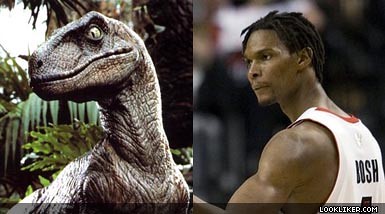
Chris Bosh: Bosh has thus far played adequate defense on Philly's Elton Brand and Boston's Kevin Garnett, limiting each guy to about 15 points per game. For his part, Bosh has averaged nearly 18 points and 10 rebounds in the playoffs, consistently giving Miami the big presence they need to keep defenses from double- or triple-teaming his mates James and Wade. Miami is 6-1 in the playoffs thus far and is the clear favorite to win the East, given injuries to the Celtics' and Bulls' best players. If the Heat defeat Boston, the velociraptor lookalike will need to raise the fury of his offensive game as the Heat move on to face stalwart defenders like Joakim Noah, Al Horford, Andrew Bynum, Kendrick Perkins, or Tyson Chandler.
Zach Randolph: Randolph has been a monster in the playoffs thus far, averaging 22 points and over 7 FT attempts (making the latter at an 87% pace), giving his team ridiculous offensive efficiency. Randolph has carved up Tim Duncan, Antonio McDyess, DeJuan Blair, Serge Ibaka, and any other defender who cares to challenge the big Hoosier. At the end of Game 6 of the Spurs series, San Antonio pulled ahead 80-79 with about five minutes left. The young Memphis team could have crumbled, but Randolph then scored 13 points down the stretch, throwing in a variety of awkward-yet-graceful parries at the basket to lead his team to a comfortable 8-point win, closing the series.
Lamar Odom: Odom has not played to his potential in these playoffs. Defending Carl Landry of the outmatched Hornets, Odom allowed the backup power forward to rumble for 16 points per night. On offense, Odom has produced only about 11 points and 7 rebounds, and only 4 total three-pointers in six games. With Ron Artest sentenced to one game out of action, Odom will enter the starting lineup tonight and will take direct responsibility for stopping Shawn Marion and/or Dirk Nowitzki.
James Harden: Harden's beard and mohawk are intimidating, but he has been a bit inconsistent in the playoffs, putting up point totals of 5, 18, 10, 7, 12, 5, and 21. His most recent output, Game 2 against Memphis, was his best, including 5 assists, 3 steals, and 11 free-throw attempts (with a perfect completion rate). However, Harden needs to stroke outside shots more consistently (he averages only one three-pointer per game) to discourage Memphis defenders from converging all their might on Durant and Westbrook. Oklahoma City's other rotation players — Perkins, Sefolosha, Ibaka, Mohammed, and Collison — are not known as major offensive threats. Only Eric Maynor's surprising long-distance result in Game 2 kept the Grizzly defense at bay, and Maynor may not repeat that.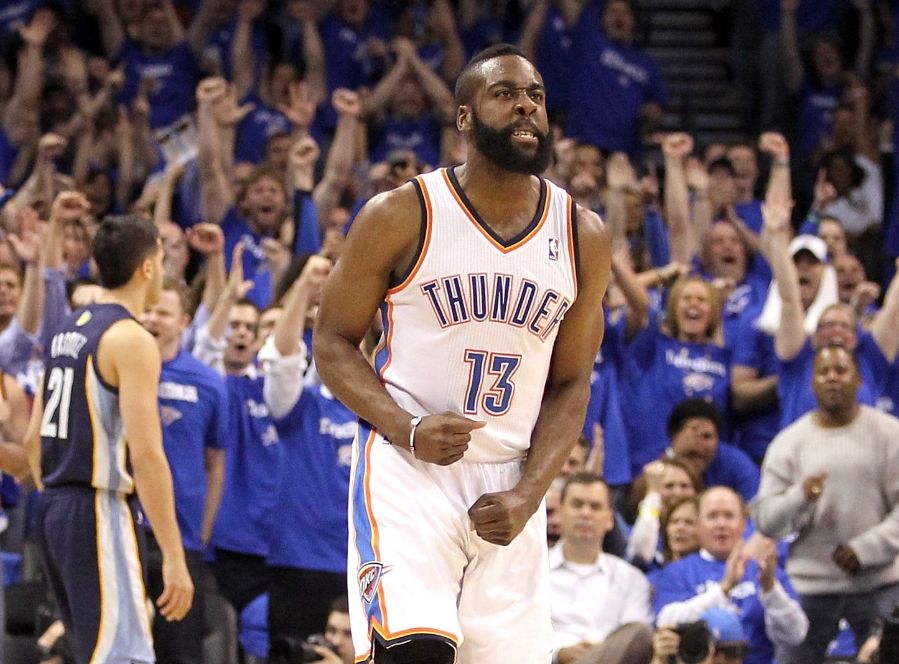
Josh Smith: Smith is, as ever, inconsistent; he is surely the most talented player to never make the All-Star Game (edging Odom, discussed above, and Monta Ellis and LaMarcus Aldridge for that designation). Here is Charley Rosen's evaluation of Smith following the Bulls-Hawks second game a couple nights ago: "Smith had only himself to blame for his abysmal 4-of-14, four-turnover performance. That’s because he forced a total of eight shots/passes/drives, with most of his turnovers being of the unforced variety." In the first-round series with Orlando, Smith did a good job of limiting Brandon Bass to only 7 PPG and 4 RPG, well below Bass's regular-season averages. But on offense Smith has been just dead weight, averaging 39% from the field, 56% from the free-throw line, and 17% from three-point range (on his 2.4 attempts per game). Smith could average 5 or 6 assists per game with his height, vision, and agility, but he peaked at 4.2 in 2009-10, and dropped to just over 3 assists this season, and just under 2.6 assists these playoffs.
Derek Fisher: Fisher has spent these playoffs allowing Chris Paul and J.J. Barea to repeatedly abuse him. Should the Lakers somehow advance to face Memphis or (particularly) Oklahoma City, Fisher's defensive weakness will become still more patent. At 6'1", Fisher was never the hulkiest of defenders against opposing PGs, and now he is nearly 37 years old. Fisher is not giving his team in credits nearly what he takes away in debits, averaging only 8.5 points and 4 assists in this postseason. But he still shoots a pretty jumper.
Mike Conley, Jr.: In his first NBA playoffs, Zach Randolph's teammate has done well against good-to-excellent point guards like Ty Lawson, Ray Felton, and Russell Westbrook. Conley has raised his scoring average slightly, from 13.7 in the regular season to 15.6 in the playoffs. Additionally, Conley has done a good job (6.5 assists against Denver and Oklahoma City) delivering the ball to his big menaces Marc Gasol and Randolph, who know how to score it. Conley reached the NCAA tournament final four years ago in his only college season, so he is not unaccustomed to serious pressure.
Manu Ginobili: This 6'6" guard is the only man on my list not still playing in May. Ginobili is a great player, but he was limited in the Memphis series by an elbow injury that he suffered when, oddly, his coach had him playing in the season's final game, which was meaningless to San Antonio's relative standings. Ginobili hit a very lucky shot to help force overtime at the end of Game 5 and averaged 20 points per game in the series, but he was unable to stop marginal offensive talents like Tony Allen and Sam Young from carving up the Spurs in the paint, and now his year is done.
Other left-handers like Tayshaun Prince, David Lee, Michael Redd, and Mike Beasley all play for 2011 lottery teams. Prince, who has seen plenty of prior playoff success, might make his way to a winning team as a free agent this summer.
Sunday, May 1, 2011
First Round of the Playoffs
With the first round over, here are some quick observations:
New Orleans had great success with the pick-and-roll against Los Angeles; on several occasions in Game 4, I saw Andrew Bynum forced to defend Chris Paul one-on-one after switches. The big man gamely saw in a defensive crouch to defend Paul, but the latter torched Bynum for swished jumpers time after time.
LaMarcus Aldridge has become very, very good in the low post. Nicolas Batum is a nice two-way player. Greg Oden, if healthy, can form an outstanding defensive line with Aldridge. Gerald Wallace is a great sixth man. All Portland misses is an All-NBA caliber guard. Unfortunately, Brandon Roy's knees are not what they were in 2009. Committed to Roy through 2015, Portland has little hope of crafting a championship contender.
I was surprised that San Antonio repeatedly had no answer for Memphis's slow, arboreal attack. Unfortunately, Antonio McDyess is too old, Matt Bonner too slow, and DeJuan Blair too short to deal with Randolph or Gasol. On the other end, one would think that Parker and Ginobili could repeatedly hit outside jumpers against the inexperienced defense of Sam Young, Mike Conley Jr., and O.J. Mayo. Unfortunately, Memphis's perimeter players (including the excellent Tony Allen) are relatively tall, and Parker is not; also, Ginobili was slowed by an elbow injury.
Denver had a full company of troops to do good combat with Oklahoma City, but they were outplayed late in their losses. Excepting the blowout Game 2, here are the fourth-quarter scores and the final scores. Game 1: Tie in 4th quarter, OKC wins by 4. Game 3: OKC by 5 in 4th quarter, by 3 overall. Game 5: OKC by 7 in 4th quarter, by 3 overall. The Thunder have Kevin Durant to get results in crunch time; Denver's best scorer is Danilo Gallinari.
The Celtics may have swept New York, but we should not infer too much from this outcome. Boston could barely defeat NY in two games at home, enjoying some lucky bounces and mental miscues by the Knicks in the fourth quarter. When the series moved to Manhattan, had little trouble dealing with a team missing Chauncey Billups and a healthy Amare Stoudemire.
Similar to Dallas's problem, Orlando fields a 5'11" point guard as its second-best player and alleged team leader. Its shooting guard going forward, J.J. Redick, is 6'4". How on earth can these guys hope to defend Derrick Rose, Dwyane Wade, or Ray Allen? They certainly couldn't do it against Joe Johnson and Jamal Crawford, who averaged 18 and 20 points, respectively, in six games of their first-round series. Worse, Orlando's contractual commitments to Hedo Turkoglu (through 2013) and Gilbert Arenas (through 2014) preclude the team from making any good trades or adding good free agents. Dwight Howard would be crazy to re-sign here.
The Pacers surprisingly kept the first three games close and won the fourth, thanks to superstar play by Danny Granger and necessary buckets from their big players, Hansbrough and Hibbert. Chicago had a difficult time pulling away from Indiana in the first four games, in part because Carlos Boozer only scored 12 PPG in those contests. Without Boozer throwing in a regular 20 points per, the Bulls generally lack scoring punch. Their first priority for improving the roster must be finding a two-way SG who can throw the ball through the rim and stop the opposing counterpart.
Like the Pacers, Philadelphia played Miami tight in four of the five games: three of Philly's losses came by 8 points or fewer. With young players like Holiday, Young, Turner, Williams, and Iguodala, the Sixers are one of the few teams in the league that can play at Miami'a fast pace; Iguodala in particular helps the 76ers run up and down while staying with Miami's stallions defensively. Only an ultra-quick or ultra-strong team can probably defeat Miami in four games out of seven. The Boston Celtics, unfortunately, reduced their strength significantly when they traded Kendrick Perkins.
Thursday, April 14, 2011
Playoff Predictions
The 2011 playoffs begin this weekend, so here are our quick thoughts:
Other than the Trail Blazers of 1977, no team has ever won the championship if its core players had not even won a single playoff series in prior years. (One could point to the 1980 champion Los Angeles Lakers featuring rookie Magic Johnson, but its other top players including Jamaal Wilkes, Michael Cooper, and Kareem Abdul-Jabbar had won a first-round series against Denver in '79. One could also look at the Celtics of 2008, who turned the previous season's 24 wins into a championship. But Pierce, Garnett, and Allen had all made it to the conference finals with different prior teams.) This is not a random correlation; beating the same opponent over and over, even as the opponent comes to know your strengths and weaknesses, is a learned skill. For that reason, I have a hard time seeing the Chicago Bulls or Oklahoma City Thunder winning the 2011 title. (The Bulls boast Boozer and the Thunder play Perkins, both of whom have seen playoff success before, but each of those guys is not among the respective team's top three players.) That is not to say that Chicago and Oklahoma cannot make the NBA Finals, but they will likely not win the big prize.
That leaves San Antonio, Los Angeles, Dallas, Miami, Boston, and Orlando as possible champs. Keep that in mind in reading the following predictions:
FIRST ROUND
SECOND ROUND
CONFERENCE FINALS
NBA FINALS
Friday, April 8, 2011
Citizen Enforcement of the Rules
In American law, private citizens' suits to enforce public rules are allowed (particularly in the environmental context) where the issues are particularly local and regulators are likely to be too far removed from the situation to reliably act. (This could be said about a variety of regulatory contexts, including finance, labor, agriculture, and so forth. One wonders, actually, why the US Congress has authorized citizen suits in environmental settings but not much elsewhere.)
In Wednesday night's Charlotte-Orlando game, Bobcats guard Gerald Henderson Jr. decided that Dwight Howard's lollygagging at the free-throw line deserved sanction. Henderson used his fingers to conspicuously count seconds while Howard stood at the line: 1... 2... 3... up to 10. When Henderson hit 10, the referees whistled Howard for a violation of the NBA rule, thus nullifying his FT attempt. (Angered, Howard tossed a ball and earned a technical foul.)
Orlando and its fans may loathe Henderson for being a jerk, but someone needed to prod the referees into action. As long noted, we at JPO want rules to be applied consistently, without regard for the identity or reputation of the players involved. If referees will not whistle Howard for his slow free-throw form, it is efficient for a guard like Henderson, who stands behind the line otherwise doing nothing while watching the FT, to incontrovertibly highlight the violation.
The NBA has a long-standing practice of fining players or coaches who publicly criticize referees. It is fair to say that the NBA does not see a need for citizen patrolling of its regulators; rather, the NBA feels that the referees are sufficiently close to the action that they should be able to see all rule violations. (This is actually a plausible story; an NBA referee can catch a slow FT attempt or a "Jordan pushed off" moment more easily than a regulator in DC or Chicago can find contaminated effluent in rural Iowa. However, a fourth referee on the court would help matters.) Will Henderson now receive a fine for his implicit critique of the Wednesday officials? Seems that the league might lose credibility if Henderson is not fined.
Thursday, April 7, 2011
Not Yet Ultimate, They Are Still Warriors
Fighting hard for playoff positioning, the Lakers exploded after the All-Star game, winning 17 of 18. Starting Sunday, though, Los Angeles dropped three straight games to teams of decreasing caliber: first Denver, then Utah, then Golden State.
In last night's game against the Warriors, Kobe Bryant and Pau Gasol shot a combined 17-for-31, putting 43 points on the scoreboard. L.A. earned 27 free-throw attempts and rebounded the ball 47 times. Meanwhile, Golden State shot 39% from the field.... and the Warriors somehow won the game by 8 points. How did they do this? Golden State rebounded the ball 50 times, including 18 offensive caroms, enabling them to launch 93 shots. (Lakers' opponents generally average 12 offensive boards per game.)
Golden State is so offensively prolific that an average defensive effort, plus a decent mess of ORB, can help them win a lot of games. (One night earlier, the Warriors thumped playoff-bound Portland by 21 points.) If rookie PF/C Ekpe Udoh becomes a reliable man in the painted area, Golden State can at least make the playoffs with its current roster. A defensively aware head coach could do very good things with the Warriors squad.
Tuesday, April 5, 2011
To enter the draft, or not?
Butler coach Brad Stevens recently observed:
Stevens wondered if the unclear situation might cause a reverse pendulum effect. If more players do not enter the draft because of the uncertainty, it could present an opportunity for others to leave early and benefit from a watered-down draft pool.
“Does that make this draft weaker? Might,” Stevens said. “So you might be able to get drafted higher. Does it make it so that nobody wants to go out because they don’t want to sit out their whole senior year and not play basketball until February?”
This presents a complicated situation of belief formation. The lockout news might persuade me to stay in college. But if I believe everyone else is staying in college due to the lockout, then perhaps I have extra incentive on the margin to enter the draft. But I know that everybody else is probably thinking the same way, so perhaps they all actually will enter the draft, and my original assumption about everyone staying in college is wrong. But wait!... if everyone is entering the draft after all, then perhaps I should stay in school. But if everyone else is thinking the same way, then doesn't that mean that everyone else is staying in college?
Und so weiter.
Of course, my paragraph above is a caricature: it is unrealistic to think that either every NBA-quality talent stays in college, or else every NBA-quality talent declares for the draft. A more realistic picture might also imply an equilibrium to this situation, i.e. an outcome where people are forming correct beliefs about their counterparts, and everyone is making good decisions based on those beliefs. The realism comes from considering heterogeneity among the would-be draftees. Maybe different players have different inclinations to enter the draft, based on their talent level, their college team's prospects, and their family's financial situation. Thus, the external shock of the lockout, though it touches all players, will affect different players differently: For some players, it might tip the difference from going pro to remaining a student. For other players who had previously decided that either staying in school or joining the draft was optimal for them, the lockout news might not shift their calculus. There is also heterogeneity in the players' reasoning ability; some will correctly think about how all the other potential draftees are thinking, and some will not. Some will correctly recognize such heterogeneity of thinking ability, and some will not. The secondary consideration of "How does this lockout news affect other players?" will thus have only secondary effects, and it is possible that, after a few players adjust their decisions, an equilibrium could be reached.
College and law school graduates unlucky enough to leave school in 2008, 2009, or 2010 found themselves facing the worst job market since at least the 1970s, and without a good starting position, their long-term career prospects may be commensurately curtailed. Similarly, 2011 potential draftees have it bad, as a lockout will kill their first paychecks and, if the 2011-12 season is completely cancelled, force them to compete, as unproven talent, with 2012 draftees for 2012-13 roster spots. (The 2012 draftees have a similar problem, though they will likely get a full season's worth of paychecks.) Unlike "normal" graduates, though, NBA prospects have the option to stay in school at university expense for a couple more years until the storm abates. And even a couple months of a minimum-salaried NBA paycheck could more than pay the bills for most American families. As a specialized monopoly industry, the NBA is hardly a good facsimile of the rest of the US economy.
Saturday, March 26, 2011
NCAA Basketball, Where Talent and Flash are Losing Horses
When I watch college basketball games, I notice that the defenders seem to exert more energy and they are more effective. Even in last night's Ohio State vs. Kentucky game, featuring at least a handful of future NBAers, I saw players frequently pick up their dribble, flummoxed, when double-teamed or challenged by a feisty face-up man. Offensive sets feature (i) a lot of perimeter passing, (ii) a complicated "weave" look, or else (iii) a total breakdown ending in an errant pass or a slapped-free ball. In the NBA, your typical player (who formerly was the very best of the best in the college circuit) has the speed, agility, and handle to dribble around a good defender; your average college man cannot. Is this because of the apparently tougher effort given by college defenders? Not exactly; the usual college player has less athletic ability than even an NBA schlub; the undergraduate needs to exert himself harder to cover a given ground in a given time.
So to recap, dribble-driving is relatively poor in the university game, and so is defense. But in the NCAA ranks, decent defense can usually trump a dribbler; in the NBA, the reverse prevails. Even future studs of pro ball-handling are usually not at their highest powers while still in college.
Consider the following talent-laden NCAA showdowns. In the NBA, this just wouldn't happen, even in one game. Yes, "anything can happen" on one night, but with the championship on the line, the best players generally raise their level of play commensurately.
Friday, March 18, 2011
Utah vs. Chicago '98
I noticed a few things in this game that had slipped from my memory:
Monday, March 14, 2011
Please, No More Pro Hoops Around The Equinox
The last month of the NBA season is no fun for anyone. The worst teams are actively tanking. The best teams are resting their starters, as the marginal change in expected wins from playing the starters 40 MPG instead of 30 MPG is unlikely to affect playoff seeding. It is only the mediocre teams churning around the 7th and 8th playoff spots (this season, the Indiana Pacers, Charlotte Bobcats, Milwaukee Bucks, Memphis Grizzlies, Houston Rockets) that actually give a darn.
The revenue boost from at least two home playoff games can be substantial for an owner. If you can fill a 20,000 seat arena at an average price of $30 per ticket, that is $600,000 per game and over $1 million if, at worst, your team gets quickly swept in four games by a real power. If your team gets lucky and defies expectations to win a playoff series (let us think of 2005's Jerome James-led Seattle Supersonics, or 2001's Raptors), that represents even more home games at higher per-seat prices. So there is good reason for the Bucks and Rockets to fight all the way to the end for the final playoff seed. [On the other hand, a better path to financial prudence would simply be not to sign the Jerome Jameses of the league to multi-million-dollar contracts.]
For the rest of us, the waning winter and "madness" of the college playoff are enough to distract us from the meaningless final weeks. I might propose that the final month of the NBA season simply be cancelled, giving playoff teams a break between mid-March and mid-April. Nearly six months of regular-season games is just too much, especially for players. Posit, further, that ticket prices could be raised for the remaining ~65 regular season games so that team revenues come out even. Some might argue that with a five-month season, the fifth month, mid-February through mid-March, would then become the doggy days wherein nobody tries. But, if you'll permit me some math for a moment, the standard deviation of the sample mean (in other words, if the team's win-loss record after playing N games is a measure of how truly good it is, how prone is the measure to error?) is inversely proportional to the square root of N. The first derivative of that function is negative, but inversely proportional to N^(3/2). Back in plain English, the "marginal reliability" effect of playing more games decreases the more games you play. The 66th through 82nd games are less meaningful than the 49th through 65th, say, games would be. As we have seen during the past few weeks, as the Bulls, Celtics, and Heat jockeyed for playoff seeding, we still don't yet know who the "best" regular season team is. But by April 1st we surely will.
Friday, March 11, 2011
Owning A Team Ain't All That
It appears today that the National Football League and its Players Association will be unable to conclude a new collective bargaining agreement, and an extended lockout will ensue. With the looming expiration of the NBA's collective bargaining agreement on July 1st, many pundits are predicting a similar work stoppage in pro hoops, and a possible cancellation or curtailment of the 2011-12 season, as happened in '98-99.
Without the players, what does assets a pro team owner "own"? Likely, you have an exclusive long-term lease with the best arena or stadium in town. You own all the intellectual property relating to your team's name, logo, colors, and so forth. You are party to various marketing deals with corporate sponsors. Finally, you are party to television and radio broadcast agreements. But without any players to populate your team and play games, all that will not get you much more than a cup of coffee. I suppose the team can still take revenue from jersey sales during a lockout/strike, but if a lockout were to drag on and the long-term viability of the league appeared questionable, merchandise sales would slow considerably, aside from sales of older vintage jerseys (aka "throwbacks", in the argot) to hipsters or serious fans.
What is to stop the NBA players from setting up their own league? Let us assume that star players like LeBron James and Dwight Howard were sufficiently charismatic that they could persuade at least a couple hundred NBA-caliber players to join them, and to find rich investors who could back the venture, and unbooked arenas that would associate with their venture. In other words, why shouldn't they form another ABA? Why shouldn't they own their own venture and draw all the residual profits?
[There are, of course, many minor-league professional hoops leagues in the United States right now, including one called the American Basketball Association with an unwieldy 60 teams. None of them has the world's best players, though; one organization has a monopoly on those guys.]
Basketball, with its flesh-baring uniforms and lack of helmets, naturally emphasizes individuals more than other team sports like baseball, hockey, or American football. Sure, soccer sets up the individual athlete for glory, particularly with the rarity of goals, but the television camera tends to take a bird's-eye view of the pitch, making each player's grimaces and bellows hard to discern. A basketball court, at 94' by 50', comprises about 7% of the surface area of a FIFA soccer field, the latter being about 100 meters by 64 meters. A roving cameraman can easily capture the blood, sweat, and tattoos of a hoopster, whereas soccer players just look small on television. Additionally, trends in cheap shoe manufacturing, easy communications technology, and favorable free-agent rules have helped to push individual basketball players into prominence relative to their team, much more so than baseball or gridiron players. So again, why shouldn't locked-out NBA players form their own league?
This recent SI.com article by law professor Michael McCann suggests, at Paragraph 10, suggests that locked-out NFL players could join other sports leagues, although he does not raise the possibility of the players starting their own league. In the NBA setting, it is important to note that under Section 9 of the NBA's Uniform Player Contract, each team effectively has the protection of a "non-compete clause": during the term of a player's contract, the team has the right to go to court and get an injunction prohibiting the player from playing "for any other person, firm, entity, or organization." However, it is unclear whether an NBA player contract would still be considered valid during a lockout. If the contracts are not in good standing during a lockout, then it seems that Section 9 would have no force. We should also note that many NBA players will become free agents on July 1st, though they are mostly middling players like Tyson Chandler and Nene Hilario. Those players certainly can escape the non-compete clause of Section 9, though, due to happenstance, the 2011 free-agent class would not be spectacular enough to support a financially sustainable new league.
It is unclear whether the non-compete clauses would be enforceable in court against Wade, James, Howard, Bryant, Paul, and the rest of the NBA's greatest stars, who would normally, without a lockout, be bound by valid contracts in 2011-12. [I welcome more advice from labor/employment law experts.] But why shouldn't they try? Should they fail, and should a new NBA labor agreement be concluded, it is unlikely that NBA owners would not welcome them back. The threat of a breakaway league is certainly a powerful negotiating position.
There would be other obstacles, too: Perhaps the existing TV networks with NBA coverage would refuse to do business with this new league, hoping to remain in good standing with the owners of the old "NBA" should the status quo ante return. But there are enough cable, satellite, and internet television channels these days that surely the new league could get distribution somewhere. The same arguments apply to the league's other business partners: corporate sponsors, apparel manufacturers, arenas. Surely some competitors might arise to fill the hollow if the old vendors and customers boycott the new league. The apparel manufacturers derive more oomph from their association with individual players, anyway.
Finally, would FIBA recognize the new league? This is not extremely important, as the new league could easily do business within the United States and Canada without dealing internationally. To orderly work with European (and, increasingly, Chinese) clubs for cross-oceanic movement of players, though, membership in FIBA would be vital. Likely, if the new league could prove viable for a couple seasons, FIBA would treat the old NBA as dead and buried.
Some will argue that the stars' competitiveness, sense of their place in history, and "respect for the game" would discourage them from such a yawning step. But what would cement their stature in time better than putting the mighty NBA owners out of business? Basketball with the world's greatest players is the same game, regardless of who runs the show.
Monday, March 7, 2011
Assessing McGrady's Historic Position
Yahoo! featured a great article yesterday about Tracy McGrady's career, focusing on his failure to develop his natural talents to excel as contemporaries like Kobe Bryant and Kevin Garnett have. Halfway through the piece, author Dan Devine notes in passing that it could be "argue[d]" that McGrady has compiled a "Hall of Fame-caliber" career. I would like to advance the negative side of this proposition.
As Devine noted, McGrady won two scoring titles with Orlando. For the greater part of the decade just completed, McGrady was a true superstar, making seven All-NBA teams (variously first team, second team, or third team) and putting together spectacular highlights (notably, his thirteen points in 35 seconds to beat San Antonio in late 2004). However, his career as a top player basically ended after the 2007-08 season. He was injured throughout 2008-09, then had microfracture knee surgery around February '09, against the wishes of Houston management. When he returned in the middle of 2009-10, the Rockets traded him for strategic reasons (to acquire some draft picks from New York), and he played sparingly for the Knicks to close the season. After signing with Detroit last summer as a free agent, McGrady showed a couple months of nice point guard play for the Pistons, but since the "player boycott" a couple weeks ago, the coach has benched him.
Let's not forget that this guy never won a playoff series. In a 2003 first-round series, Orlando went up 3-1 on Detroit, but lost the series. In 2005, Houston won the first two games on the road of a first-round series against Dallas. But somehow the Mavericks won the series in seven. In 2007, the Rockets won the first two games of a first-round series against Utah, but lost Game 7 of that series. [Utah then inherited overmatched Golden State as a second-round opponent and skated into the Western finals, winning the Warriors series in five.] With Yao Ming and Dikembe Mutombo, the Rockets could have matched up well with the Spurs in the Western Conference Finals, and would have been favored in a potential NBA Finals matchup with the Cleveland Cavaliers of LeBron James and Larry Hughes. But in the event, none of that happened.
McGrady's Rockets lost again to Utah in 2008. Houston finally won a playoff series in 2009, without McGrady.
For all his talent, McGrady could never deliver in April (let alone May or June). The Hall of Fame tends to favor winners of questionable individual greatness (James Worthy, who was good but never an MVP candidate) over lovable losers (Chris Mullin, who has been unsuccessfully nominated for the Hall in every year since 2007). Even putting aside that rubric, I do not find McGrady's individual merit to be enough for the Hall of Fame. Eight seasons (2000-01 through 2007-08) of high-level play is not enough.
Tuesday, March 1, 2011
Finally, Revenge on Hollywood for "Juwanna Mann"
Did anyone else find it weird that ESPN featured two NBA games on Sunday night (Knicks vs. Heat and Blazers vs. Hawks), starting at 8:00 PM EST? ESPN is not normally in the habit of showing Sunday night games, and ESPN's corporate affiliate, ABC, was broadcasting the Academy Awards starting at 8:00. Why cannibalize your sister network's ratings?
To be fair, the overlap of fandom for NBA action and Hollywood glamour is probably not extensive, and basketball fans would be angered if the Knicks-Heat game, featuring four of the top five scorers in the league, were not nationally televised. Still, the decision was risky from the perspective of Disney's overall content strategy. And today came news that the TV audience for the Oscar show was down 10% from 2010's viewership (though, to be fair, still greater than 2008 and 2009 numbers). Ratings information for Sunday night's Knicks-Heat battle is not yet available, though I will post it once I can find it. ... UPDATE: The Knicks-Heat game drew 4.2 million viewers, the most popular show on cable television that night. Had those 4 million viewers been added to the 37 million Oscar viewers, the 2011 Oscars would have bested the roughly 41 million viewers of the 2010 Academy Awards.